Growth Changes Your Risk Before It Changes Your Revenue
Most NEMT businesses begin with a simple structure.
One vehicle. One driver. One set of responsibilities.
At that stage, insurance feels straightforward. You understand your routes, your passengers, and your daily operations. Risk feels visible because you are directly managing it.
But as your business grows, something important happens — and it often happens quietly.
Your risk changes before your revenue stabilizes.
You add vehicles. You hire drivers. You take on more contracts. Operations expand across different routes, schedules, and passenger types. And while your business is growing, your insurance exposure is evolving even faster.
This is where many operators make a critical mistake.
They assume their insurance will naturally scale with their business.
It doesn’t.
Because insurance is not designed around growth. It is designed around risk — and risk becomes more complex the moment you move from an owner-operator model into a fleet.
What Is Owner-Operator NEMT Insurance — and Why It Works So Well
At the owner-operator level, insurance works efficiently because everything is controlled.
You are the driver. You manage the vehicle. You make real-time decisions. You understand your own habits, your own limitations, and your own level of caution.
From an underwriting perspective, this creates clarity.
There is a single risk profile. A single pattern of behavior. A predictable level of exposure.
That predictability allows insurance carriers to price more confidently. It also allows claims to move more smoothly, because there are fewer variables to evaluate.
In many ways, owner-operator insurance is built on a simple truth: the person managing the risk is the same person creating it.
That alignment is powerful.
But it does not scale.
The Moment You Become a Fleet: What Actually Changes
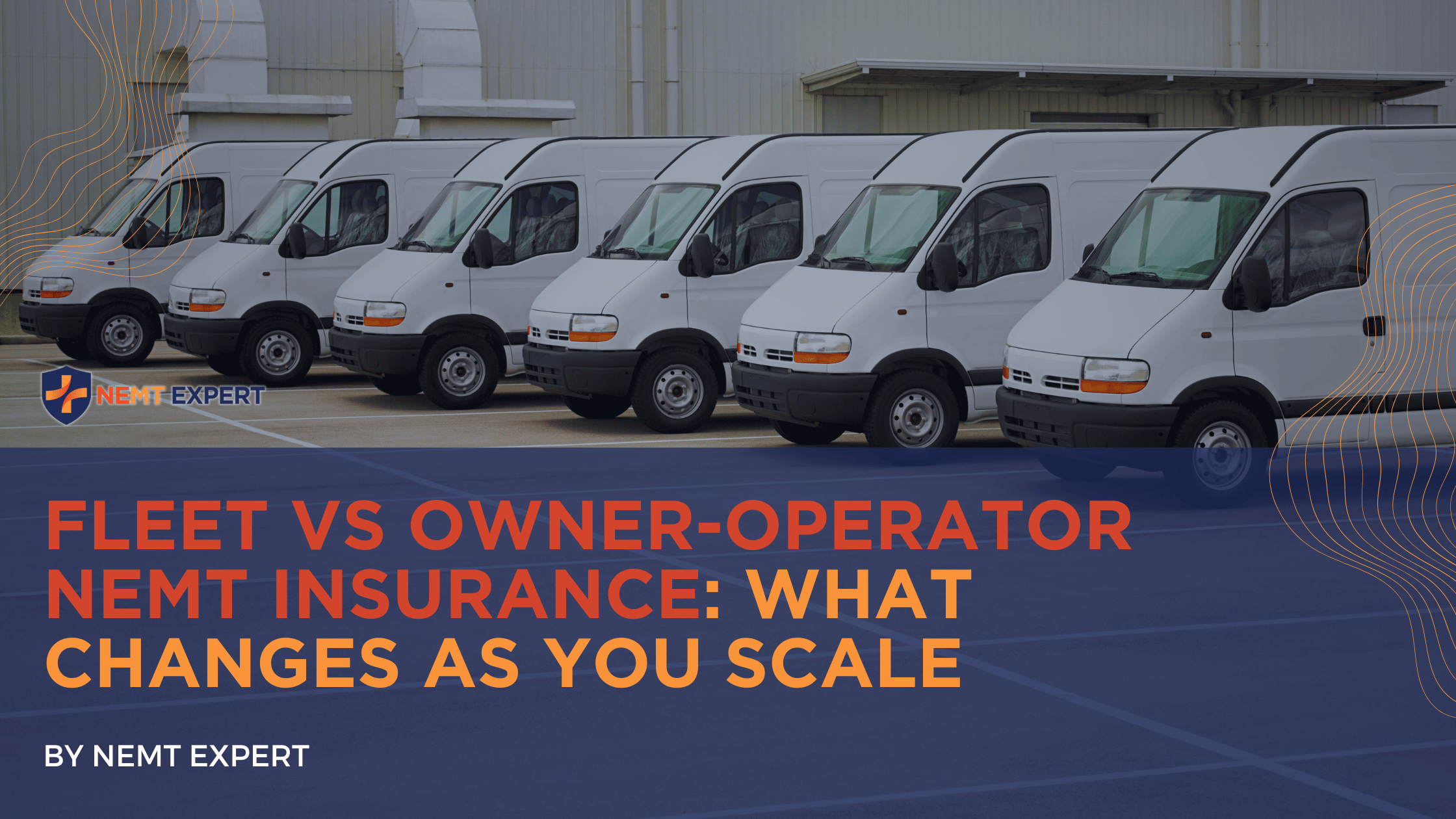
The transition from owner-operator to fleet is not just a matter of adding vehicles.
It is a shift in how risk is created and managed.
When you bring in additional drivers, you introduce variability. Each driver has a different level of experience, different habits, different judgment, and different reactions under pressure.
Even if your vehicles remain the same, your exposure does not.
You are no longer managing risk directly. You are managing the systems that control risk.
This is the moment when insurance becomes more than a policy.
It becomes a reflection of how well your business is structured.
And from an underwriting standpoint, the key question changes from:
“How safe is this driver?”
to
“How controlled is this operation?”
Why NEMT Fleet Insurance Is Fundamentally Different
Once you enter the world of NEMT fleet insurance, the rules change.
Insurance carriers are no longer evaluating a single driver or a single vehicle. They are evaluating an entire operation — and more importantly, how consistent that operation is across multiple moving parts.
They begin to look for patterns instead of snapshots.
They look at how drivers are hired, how they are trained, how incidents are reported, and how vehicles are maintained over time.
What matters is no longer just what happens on the road.
What matters is what happens behind the scenes.
And this is where many growing fleets struggle.
Because while operations expand quickly, systems often lag behind.
The Real Shift: From Personal Control to Operational Discipline
One of the most important changes that occurs during scaling is the loss of direct control.
As an owner-operator, control is immediate. You feel it in every decision you make while driving. You adjust in real time.
As a fleet, control becomes indirect.
You are no longer the one behind the wheel. Instead, you are relying on policies, training, and oversight to influence behavior.
This means your business must replace personal judgment with operational discipline.
Insurance carriers recognize this shift immediately.
They evaluate whether your business has:
- Defined hiring standards
- Consistent onboarding processes
- Ongoing driver monitoring
- Clear incident reporting procedures
If these systems are weak or inconsistent, risk appears unstable — even if your intentions are good.
And when risk appears unstable, premiums rise accordingly.
Why Premiums Increase Faster Than Your Fleet
Many operators expect insurance costs to increase proportionally with growth.
If you double your vehicles, you might expect your premium to double.
But that’s not how it works.
Insurance pricing in NEMT is heavily influenced by uncertainty. As fleets grow, uncertainty increases — especially around driver behavior and operational consistency.
Even if your business is performing well, the perception of risk expands.
This is why premiums often increase at a faster rate than fleet size.
Without structured fleet risk management, growth introduces unpredictability. And unpredictability is expensive.
Driver Risk: The Most Unpredictable Variable
Among all the changes that occur during scaling, driver risk is the most impactful.
Vehicles can be standardized. Routes can be optimized. Systems can be designed.
But people introduce variability.
Every new driver adds a new layer of exposure. Not just in terms of driving ability, but also in decision-making, communication, and adherence to procedures.
From an insurance perspective, this creates a moving target.
Even one poorly trained or poorly monitored driver can affect your entire fleet’s risk profile.
This is why successful fleets invest heavily in:
- Structured hiring processes
- Consistent training programs
- Ongoing performance evaluation
Because controlling driver behavior is the closest thing a fleet has to controlling risk.
Claims Frequency: The Hidden Cost of Growth
As your fleet grows, the number of daily interactions increases significantly.
More trips. More passengers. More drivers. More opportunities for small things to go wrong.
These are not always major accidents.
Often, they are minor incidents — a small collision, a passenger slip, a handling mistake.
Individually, they may seem insignificant.
But collectively, they create a pattern.
And insurance carriers pay close attention to patterns.
Multiple small claims across different drivers can signal a lack of control within the operation. Over time, this has a greater impact on renewal pricing than a single large claim.
This is why scaling successfully is not just about preventing major incidents.
It is about reducing frequency across the board.
Why Coverage Structure Must Evolve With Your Business
One of the most common mistakes growing fleets make is holding onto an insurance structure that was designed for a much smaller operation.
What worked for one vehicle does not work for ten.
As your fleet expands, your policy must adapt to reflect:
- Increased exposure
- Broader operational scope
- More complex contractual obligations
- Greater variability in risk
This often requires a deeper evaluation of how your coverage is built.
Deductibles, liability limits, and classifications must all be aligned with your current operations — not your past structure.
If your coverage does not evolve, it becomes outdated.
And outdated coverage creates gaps that only become visible during claims or renewals.
Renewal Becomes a Strategic Process — Not a Routine One
At the owner-operator level, renewals tend to be straightforward.
At the fleet level, they become strategic.
Insurance carriers are no longer evaluating a single year. They are evaluating trends over time.
They want to understand how your fleet is performing, how your risk is evolving, and how your systems are improving.
If your operation appears inconsistent, pricing becomes conservative.
If your operation demonstrates control, pricing becomes more flexible.
This is why preparation matters.
The most successful fleets begin preparing for renewal months in advance, ensuring that their data, documentation, and operational improvements are clearly reflected in their policy.
Documentation: The System That Replaces Visibility
As your fleet grows, visibility decreases.
You can no longer personally observe every driver, every trip, and every interaction.
Documentation becomes your proxy.
It tells the story of your operation to the insurance carrier.
It shows how drivers are trained, how incidents are handled, and how risks are managed.
Without documentation, insurers are left to assume.
With documentation, you provide proof.
And in insurance, proof is what builds confidence — and better pricing.
The Hidden Risk of Scaling Too Quickly
Growth creates opportunity, but it also creates pressure.
New contracts require more vehicles. More vehicles require more drivers. And rapid hiring often leads to shortcuts.
When systems are not in place, scaling can outpace structure.
This is where problems begin to form beneath the surface.
They may not appear immediately. Operations may seem smooth at first.
But over time, these gaps show up — during renewals, audits, or claims.
And by that point, they are more difficult to correct.
The Long-Term Impact of Properly Structured Fleet Insurance
When insurance is aligned with your operations, the benefits compound over time.
Premiums become more stable. Claims become more predictable. Renewals become less stressful.
Instead of reacting to problems, your business operates with control.
This creates something that many fleets struggle to achieve:
Consistency.
And consistency is what allows a business to grow sustainably.
Final Thoughts: Growth Requires More Than More Vehicles
Scaling your NEMT business is not just about adding vehicles.
It is about building a structure that can support that growth.
Insurance is part of that structure.
When your NEMT fleet insurance reflects your operations accurately, it becomes a tool for stability.
When it doesn’t, it becomes a source of risk.
The difference is not growth itself.
The difference is how that growth is managed.
Ready to Scale Without Insurance Surprises?
If your fleet is growing — or planning to grow — this is the time to review your insurance structure.
A professional review can help you align your coverage with your operations, identify potential gaps, and prepare for future growth with confidence.
Book a Policy Review or Discovery Call today.
Because the best time to fix your insurance…
is before your fleet outgrows it.