
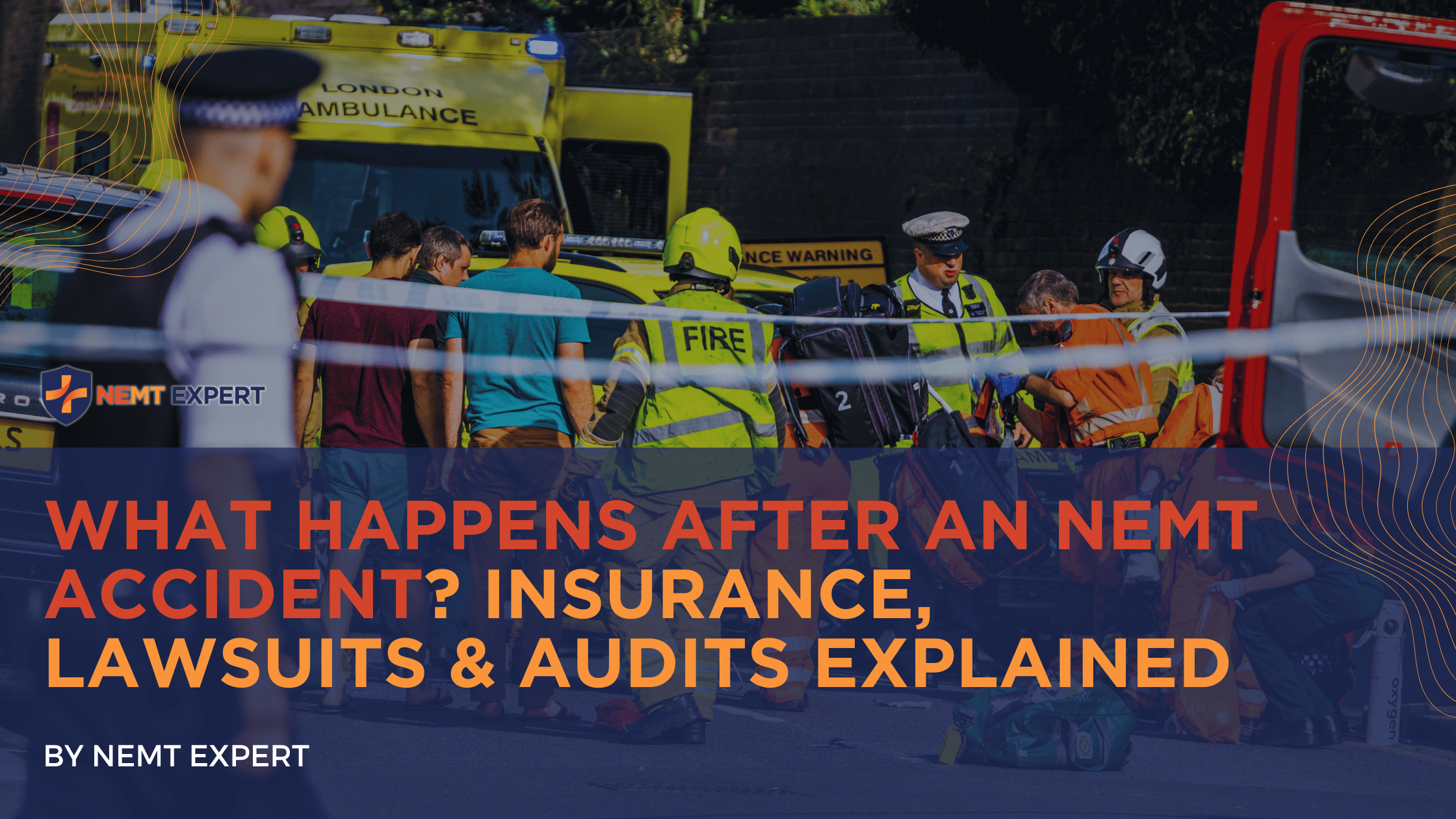
Introduction: An NEMT Accident Is Never Just an Accident
When most fleet owners think about accidents, they think about vehicle damage.
A collision happens. Insurance is notified. Repairs begin.
But in the Non-Emergency Medical Transportation industry, accidents rarely stop there.
An NEMT accident can trigger a chain reaction involving:
- Insurance investigations
- Passenger injury claims
- Contract reviews
- Compliance audits
- Legal exposure
- Operational scrutiny
And in many cases, the accident itself becomes only one part of a much larger process.
This is what many operators underestimate.
Because after an accident, insurers, attorneys, brokers, and regulators are not just evaluating what happened on the road.
They are evaluating the structure behind the operation.
How the fleet was managed.
How the driver was trained.
How the incident was documented.
Whether procedures were followed consistently.
This is why understanding NEMT accident insurance is not just about knowing your policy.
It is about understanding what happens after the incident—when the real financial and operational consequences begin.
The First 24 Hours After an NEMT Accident
The first day after an accident is often the most critical.
Not because every detail must immediately be resolved, but because the first 24 hours establish the foundation for everything that follows:
- Insurance handling
- Liability interpretation
- Legal positioning
- Audit exposure
In many cases, the long-term outcome of a claim is influenced less by the accident itself and more by how the response was managed immediately afterward.
This is where structured fleet procedures become essential.
Why NEMT Accidents Trigger More Scrutiny Than Standard Commercial Claims
NEMT accidents are different from ordinary commercial vehicle incidents because they involve medically vulnerable passengers.
This changes how insurers and legal teams evaluate risk.
An accident involving a standard commercial vehicle may focus primarily on:
- Vehicle damage
- Driver fault
- Property liability
But NEMT accidents introduce additional layers:
- Passenger medical vulnerability
- Assisted transportation responsibilities
- Mobility equipment involvement
- Duty-of-care expectations
Because of this, insurers often conduct deeper investigations into:
- Driver conduct
- Passenger handling procedures
- Documentation quality
- Operational consistency
This is where many fleets begin to experience exposure they did not anticipate.
Step One: The Insurance Claims Process Begins Immediately
After an accident, the insurance process begins almost immediately.
Even before liability is fully determined, insurers start gathering information to assess exposure.
This includes:
- Driver statements
- Passenger details
- Police reports
- Vehicle information
- Internal fleet documentation
At this stage, insurers are not only evaluating what happened.
They are evaluating the credibility and consistency of the operation itself.
Strong documentation and structured reporting create confidence.
Inconsistent information creates uncertainty.
And uncertainty increases scrutiny.
Why Documentation Matters More Than Most Fleet Owners Realize
In the aftermath of an NEMT accident, documentation becomes one of the most important forms of protection.
Insurers rely heavily on documentation to reconstruct:
- The sequence of events
- Driver behavior
- Passenger condition
- Operational procedures
If records are incomplete or inconsistent, the claims process becomes more complicated.
Not necessarily because liability automatically increases—but because clarity decreases.
And in insurance, unclear situations often lead to:
- Longer investigations
- Delayed claims resolution
- Increased legal review
- More conservative claim handling
Documentation does not just support claims.
It shapes how claims are interpreted.
Passenger Injuries Change Everything
When passengers are involved, the complexity of an accident increases significantly.
This is especially true in NEMT because many passengers already have pre-existing medical conditions or mobility limitations.
Even relatively minor accidents can lead to complicated injury evaluations.
Insurers and attorneys begin asking:
- Was the passenger properly secured?
- Were mobility devices handled correctly?
- Was assistance provided according to procedure?
- Did the accident worsen a pre-existing condition?
These questions extend far beyond standard auto claims.
This is why passenger-related incidents often become the most expensive category of fleet legal risk.
The Hidden Risk of Post-Accident Statements
One of the most overlooked aspects of the claims process is communication after the accident.
Statements made by drivers, staff, or operators can influence how liability is interpreted.
This includes:
- Informal explanations
- Incomplete reports
- Contradictory accounts
- Emotional reactions immediately after the incident
Inconsistency creates exposure.
Insurance carriers look for alignment between:
- Driver reports
- Internal documentation
- External investigation findings
When narratives conflict, investigations become more aggressive.
Why Small Accidents Can Still Lead to Lawsuits
Many fleet owners assume lawsuits only happen after catastrophic accidents.
But in NEMT operations, even seemingly minor incidents can escalate legally.
This happens because lawsuits are not always driven by vehicle damage severity.
They are often driven by:
- Passenger vulnerability
- Medical complications
- Perceived negligence
- Documentation gaps
For example, a low-speed incident involving an elderly passenger can still lead to significant legal review if the passenger later reports pain, mobility complications, or aggravated medical conditions.
This is why even “minor” accidents require serious procedural handling.
The Role of Attorneys in NEMT Accident Claims
Once injuries are involved, attorneys often enter the process quickly.
Their role is to evaluate:
- Liability exposure
- Procedural consistency
- Potential negligence
- Insurance limits
At this stage, every operational detail matters.
Driver training records.
Maintenance logs.
Passenger assistance procedures.
Incident reporting timelines.
What may have seemed like internal administrative practices suddenly become legal evidence.
This is why strong fleets build operational discipline before accidents occur—not after.
How Compliance Audits Can Be Triggered After an Accident
One major issue many operators underestimate is audit exposure.
After serious incidents, brokers, Medicaid entities, or transportation partners may review the fleet’s compliance structure.
This can include:
- Driver qualification files
- Vehicle maintenance records
- Insurance compliance verification
- Passenger handling procedures
An accident may become the event that triggers broader operational scrutiny.
This is particularly true if:
- Multiple claims occur over time
- Documentation appears inconsistent
- Regulatory requirements were not fully maintained
In these situations, the operational consequences can extend far beyond the original accident itself.
Why Fleet Legal Risk Increases as Operations Scale
As fleets grow, accident exposure naturally increases.
More vehicles create more opportunities for incidents.
But growth also creates another challenge:
Reduced operational visibility.
At smaller scales, owners often directly oversee drivers and procedures.
At larger scales, consistency depends on systems—not individual supervision.
This is why fleet legal risk increases rapidly when operational structure does not scale alongside growth.
Without standardized reporting, training, and compliance systems, accidents become harder to control legally and operationally.
The Insurance Investigation: What Carriers Are Really Evaluating
Many fleet owners believe insurance investigations focus only on fault.
In reality, carriers are evaluating much broader questions:
- Is this fleet operationally stable?
- Are procedures standardized?
- Is driver oversight consistent?
- Are claims likely to repeat?
This means insurers are evaluating future risk—not just past events.
A single accident can therefore influence:
- Future premiums
- Renewal pricing
- Carrier appetite
- Coverage flexibility
This is why claims management is directly tied to long-term insurance strategy.
Why Repeat Claims Create Long-Term Exposure
One accident may be manageable.
Patterns are far more dangerous.
When insurers identify repeated incidents across a fleet, they begin to interpret claims as indicators of systemic operational issues.
This leads to:
- Higher premiums
- Stricter underwriting
- Reduced market options
- Increased audit scrutiny
The issue is not just claim volume.
It is what repeated claims suggest about operational control.
How Strong Fleets Protect Themselves After Accidents
The strongest fleets approach accident response strategically.
They do not rely on improvisation.
Instead, they implement:
- Structured reporting systems
- Standardized communication protocols
- Consistent driver training
- Strong documentation procedures
These systems create stability during high-pressure situations.
And stability improves both legal and insurance outcomes.
The Real Cost of an NEMT Accident
The true cost of an accident often extends far beyond repairs.
It can include:
- Increased premiums
- Legal expenses
- Lost contracts
- Operational downtime
- Audit exposure
- Reputation damage
In some cases, the long-term financial impact of the aftermath exceeds the direct cost of the incident itself.
This is why accident prevention and structured response are both essential components of fleet risk management.
Final Thoughts: Accidents Reveal the Strength—or Weakness—of Your Fleet Structure
An NEMT accident does not just test your driver.
It tests your entire operation.
It reveals whether your:
- Insurance structure
- Documentation systems
- Driver procedures
- Compliance practices
are strong enough to withstand scrutiny.
The fleets that recover best after accidents are not necessarily the ones with the fewest incidents.
They are the ones with the strongest systems.
Because in the NEMT industry, accidents are never evaluated in isolation.
They are evaluated as reflections of operational control.
Protect Your Fleet Before an Accident Becomes a Legal and Insurance Problem
If your fleet is growing—or already operating at scale—now is the time to review your insurance and risk management structure.
A proactive review can help you:
- Identify operational gaps
- Improve post-accident procedures
- Strengthen documentation systems
- Reduce long-term liability exposure
Book a Policy Review or Discovery Call today.
Because after an accident happens…
your systems matter just as much as your coverage.