
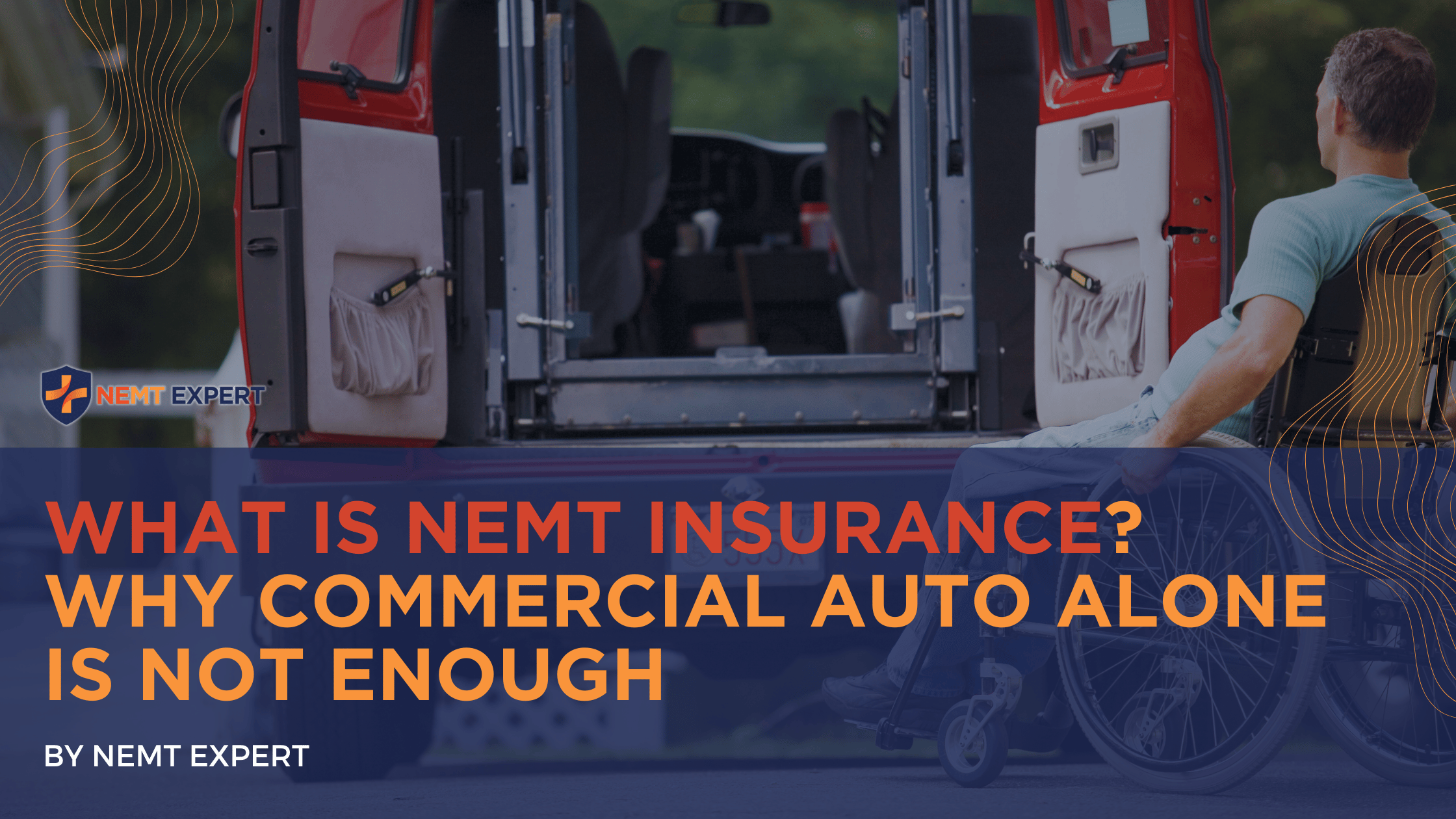
Non-Emergency Medical Transportation (NEMT) is one of the fastest-growing segments in healthcare support services. As the population ages, Medicaid programs expand, and home-based care becomes the norm, more transportation providers are stepping in to fill a critical gap: getting patients safely to and from medical appointments.
But while many new and even established NEMT operators focus heavily on vehicles, routing, and contracts, one of the most misunderstood—and most dangerous—areas of the business is insurance.
A common assumption still persists across the industry: “If I have commercial auto insurance, I’m covered.”
In reality, that belief has cost NEMT operators millions in uncovered claims, denied lawsuits, lost contracts, and even business closures.
This article breaks down what NEMT insurance actually is, why commercial auto insurance alone is not enough, and how the right coverage protects not just your vehicles—but your entire operation.
Understanding What NEMT Really Is (From an Insurance Perspective)
Non-Emergency Medical Transportation is not simply “driving people.” From an insurance carrier’s standpoint, NEMT is a high-liability healthcare-adjacent service.
You are transporting:
- Elderly passengers
- Disabled individuals
- Wheelchair users
- Patients recovering from surgery
- Individuals with mobility, cognitive, or medical vulnerabilities
This instantly changes your risk profile.
Unlike rideshare or courier services, NEMT providers are responsible for passenger handling, physical assistance, securement of mobility devices, and duty-of-care expectations that go far beyond operating a vehicle.
Insurance companies don’t just insure what you do — they insure what can go wrong.
And in NEMT, the things that can go wrong extend far beyond traffic accidents.
Why Commercial Auto Coverage Falls Short for NEMT Providers
Commercial auto insurance is essential. There’s no question about that. It forms the backbone of any transportation business.
However, commercial auto insurance was never designed to protect NEMT-specific risks.
Commercial auto typically covers:
- Bodily injury and property damage caused by a vehicle accident
- Damage to other vehicles
- Damage to property
- Basic medical expenses related to an auto collision
What it usually does not cover are the risks that happen:
- Before the vehicle moves
- After the vehicle stops
- Inside the vehicle, unrelated to a collision
- During passenger assistance
And in NEMT, that’s where many of the most serious claims occur.
Where NEMT Risk Actually Lives (And Why Claims Get Denied)
To understand why NEMT insurance is different, it helps to look at real-world claim scenarios.
An NEMT driver helps a passenger out of a wheelchair and onto a seat. The passenger slips and fractures a hip.
No accident occurred. The vehicle never moved.
A driver improperly secures a wheelchair. During a normal turn, the chair shifts and the passenger is injured.
Again, no collision — but a serious bodily injury.
A passenger alleges mistreatment, emotional distress, or improper assistance during transport.
This becomes a liability claim, not an auto claim.
A facility sues the transportation provider after a patient arrives injured, late, or unfit for treatment.
Now you’re facing professional and contractual exposure.
These are not commercial auto claims — and carriers regularly deny them when no NEMT-specific coverage is in place.
So What Is NEMT Insurance?
NEMT insurance is not a single policy. It is a coverage ecosystem built specifically for the operational, legal, and contractual risks of medical transportation.
At its core, NEMT insurance typically includes:
- Commercial Auto Insurance (properly rated for NEMT use)
- General Liability Insurance
- Professional Liability / Errors & Omissions
- Non-Owned & Hired Auto (if applicable)
- Workers’ Compensation
- Sexual Abuse & Molestation coverage (often required)
- Umbrella / Excess Liability
The key difference is not just having these policies — it’s how they are classified, written, and coordinated.
An NEMT policy must accurately reflect:
- Passenger assistance
- Wheelchair operations
- Stretcher or ambulatory services
- Medicaid or broker contracts
- Healthcare-adjacent risk
If your policy is written incorrectly, coverage gaps still exist even if you “have insurance.”
Why General Liability Is Just as Important as Auto
One of the most overlooked NEMT coverages is general liability insurance.
General liability protects your business against:
- Slip-and-fall injuries
- Passenger injuries outside of vehicle movement
- Allegations of negligence during assistance
- Third-party bodily injury not caused by a collision
For NEMT providers, general liability is often where most claims land.
Without it, operators often discover too late that their commercial auto carrier has no obligation to defend or pay.
This is especially critical for:
- Wheelchair transports
- Door-to-door or door-through-door services
- Assisted entry and exit
- Facility-based pickups and drop-offs
Professional Liability Exposure in Non-Emergency Medical Transportation
Many operators are surprised to learn that NEMT can trigger professional liability exposure.
Passenger Handling Is the Highest NEMT Risk Area
If your service includes:
- Passenger assessments
- Medical-related transport decisions
- Handling passengers with special needs
- Contractual service standards with brokers or facilities
Then allegations of improper service, failure to follow procedures, or negligent assistance can fall under errors and omissions rather than auto or general liability.
Professional liability fills a gap that auto and GL simply do not touch.
How Medicaid and Broker Contracts Increase Insurance Risk
If you work with:
- Medicaid
- Transportation brokers
- Managed care organizations
- Hospitals or dialysis centers
- Assisted living or nursing facilities
Your insurance is not just protection — it’s a contractual requirement.
Most NEMT contracts require:
- Specific liability limits
- Proper NEMT classification
- Additional insured endorsements
- Waivers of subrogation
- Proof of abuse/molestation coverage
- Higher umbrella limits
Having “some insurance” is not enough.
Having the wrong insurance can cost you contracts, delay onboarding, or trigger audits.
Why New NEMT Operators Are Most Exposed to Insurance Gaps
For new NEMT businesses, insurance mistakes usually happen early — and quietly.
Common issues include:
- Using a livery or taxi policy instead of NEMT-rated coverage
- Failing to disclose wheelchair or assisted transport
- Buying minimum limits to save money
- Skipping general liability or E&O entirely
- Relying on a broker unfamiliar with NEMT operations
These mistakes don’t show up immediately. They surface only when a claim is filed — when it’s already too late to fix.
Cost vs. Risk: The False Economy of “Cheapest Insurance”
Many operators choose insurance based on monthly premium alone.
But in NEMT, the cheapest policy often becomes the most expensive mistake.
When Service Standards Become Liability Claims
A denied claim can mean:
- Legal defense costs
- Out-of-pocket settlements
- Contract termination
- License suspension
- Business closure
The right NEMT insurance is not about paying more — it’s about paying correctly.
How Proper NEMT Insurance Protects Your Business Long-Term
When structured correctly, NEMT insurance does more than satisfy requirements.
It:
- Protects your drivers and passengers
- Shields your personal and business assets
- Keeps contracts active and compliant
- Builds credibility with brokers and facilities
- Allows you to scale confidently
- Reduces financial shock from claims
Insurance becomes a growth tool, not just a compliance checkbox.
The Bottom Line: Commercial Auto Alone Is Not Enough
If you take away one thing from this article, let it be this:
NEMT is not a standard transportation business, and it cannot be insured like one.
Commercial auto insurance is necessary — but it is only one piece of a much larger protection strategy.
Without NEMT-specific coverage, your business is exposed in the very areas where claims are most likely to occur.
What Smart NEMT Operators Do Next
Experienced NEMT operators don’t wait for a claim to test their coverage.
They:
- Review policies annually
- Confirm NEMT classification
- Align coverage with contracts
- Adjust limits as they scale
- Work with specialists who understand NEMT risk
If you’re unsure whether your current insurance truly protects your operation, that uncertainty itself is a warning sign.
Ready to Find Out If You’re Actually Covered?
If you operate — or are planning to launch — an NEMT business, a no-cost NEMT insurance policy audit can help identify gaps before they turn into claims.
A proper review looks at:
- Coverage types
- Limits
- Classifications
- Contract compliance
- Growth readiness
Because in NEMT, the question isn’t if risk exists — it’s whether you’re protected when it shows up.